Poster Presentation World Lake Conference 2025
Impact of floating photovoltaic systems on water quality (#227)
Floating photovoltaics (FPVs) are solar power plants installed on water body surfaces to meet renewable energy demands. However, the effects of FPVs on the thermal properties and dissolved oxygen (DO) levels of water bodies, particularly shallow ponds, are largely unknown.
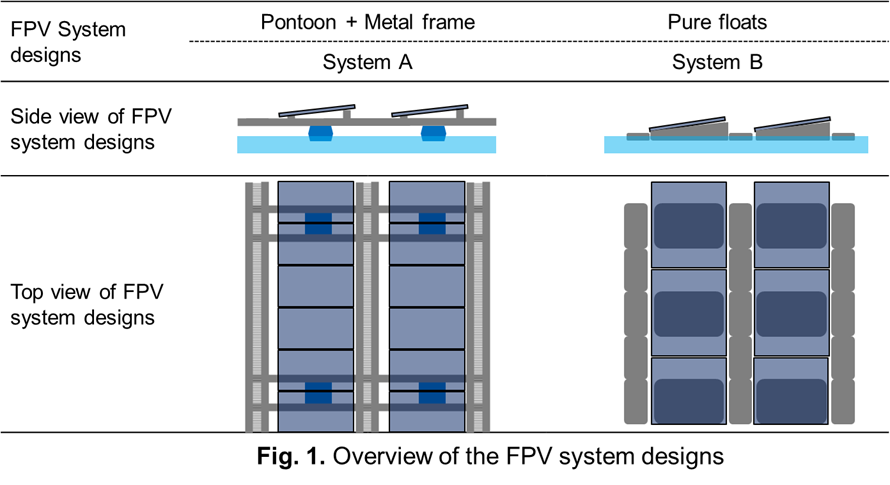
This study examined the effects of different FPV designs on the water quality of two irrigation ponds in Japan. Each pond was covered with a different FPV system. System A consisted of solar modules mounted to metal frames, which were in turn mounted to polyethylene floaters. System B was based on a set of configurations using specially designed buoyant bodies to directly support solar modules (Fig. 1).
The irrigation ponds had an average depth of 3.5 m. System A covered 33% of the 18,000 m2 water area, whereas System B covered 50% of the 25,000 m2 water area. We hypothesize that the two FPV configurations have distinct interactions with their aquatic environments. In both ponds, water quality sensors monitored surface water DO levels and temperatures continuously at two different sites: (i) underneath the FPV system and (ii) at a reference site positioned in open water. There were significant reductions in irradiance during daylight hours, with System A and B causing 93% and 99% reductions, respectively, compared to open water. The closed coverage by System B also resulted in no wind movement underneath the FPV system, in contrast to the 60% reduction in wind speed observed under System A compared to open water. The temperature variations further highlighted the differing impacts of the systems. System B led to a daily maximum water temperature gap between the surface water under the FPV system and open water of -2.2 °C, during the day, and a +0.20 °C average increase at night. Conversely, System A resulted in a daytime temperature gap of -1.7 °C and a nighttime average increase of +0.23 °C. Furthermore, DO levels under the FPV system were affected, with System B and System A causing decreases of 0.36 mg/L and 0.23 mg/L, respectively, compared to open water. The findings indicate that System A, with its less enclosed design, experienced lower reductions in both DO and daytime water temperature.
The results underscore the influence of FPV configurations on environmental variables and offer valuable insights for optimising the design and deployment of such systems to minimize their ecological impacts.