Poster Presentation World Lake Conference 2025
Experiments on the recovery of poor oxygen from the bottom layer of a eutrophic (#218)
Inflow load reduction is carried out to prevent eutrophication of closed water areas. However, the effect of reducing the inflow load is reduced by the leaching of phosphorus from the bottom sediment deposited in lakes during the summer. This phenomenon is caused by a decrease in the oxygen concentration in the bottom layer during the summer.
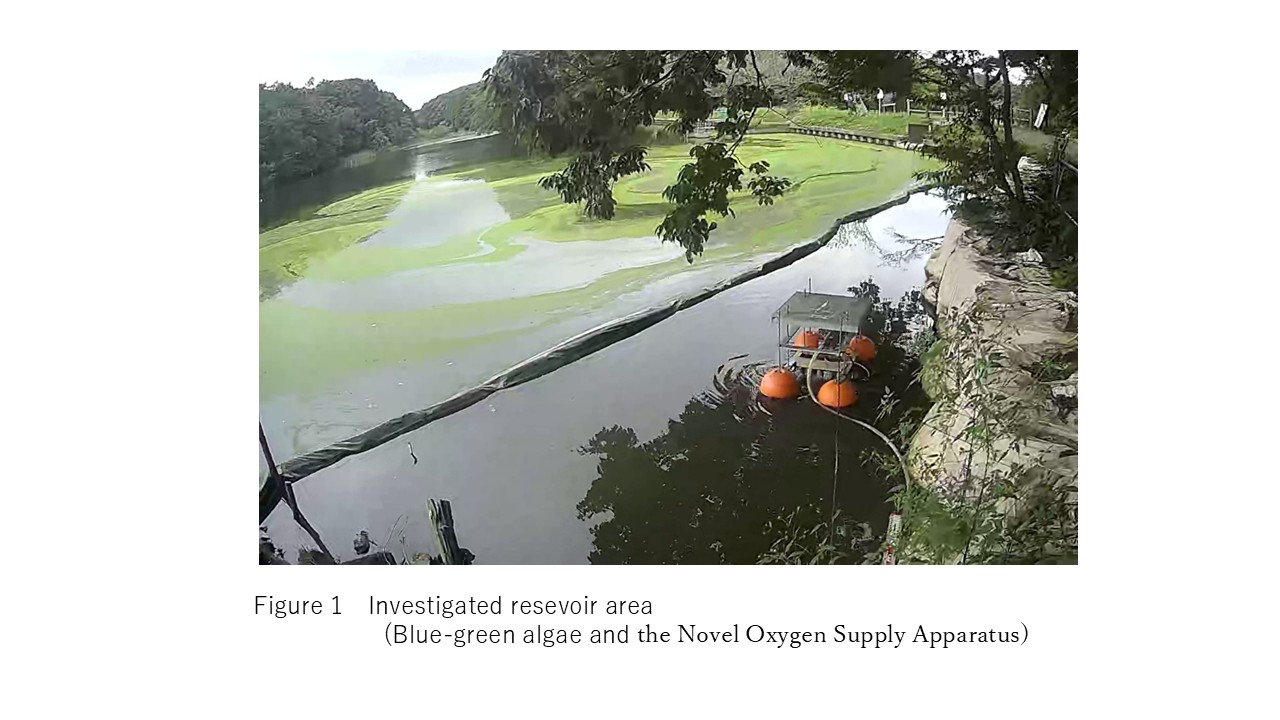
The purpose of this study was to prevent the decrease in oxygen concentration in the bottom layer of a reservoir, which is smaller than a lake, by using a pond as an example. Reservoirs in Japan have been constructed for paddy field irrigation. The investigated reservoir has become eutrophication, and blue-green algae have been observed in summer (Figure 1). However, there is a non-point source in the reservoir basin, and leaves from forests and feces of migratory birds are thought to be the cause. This is because the organic matter in the bottom sediment decomposes during the summer, and the bottom layer becomes poor oxygen.
This study was to supply oxygen to the bottom layer to suppress poor oxygen by using the Novel Oxygen Supply Apparatus to solve this problem. The experiment compared the water quality of the reservoir with that of an aeration area (separated by an oil fence) in which the Novel Oxygen Supply Apparatus was installed.
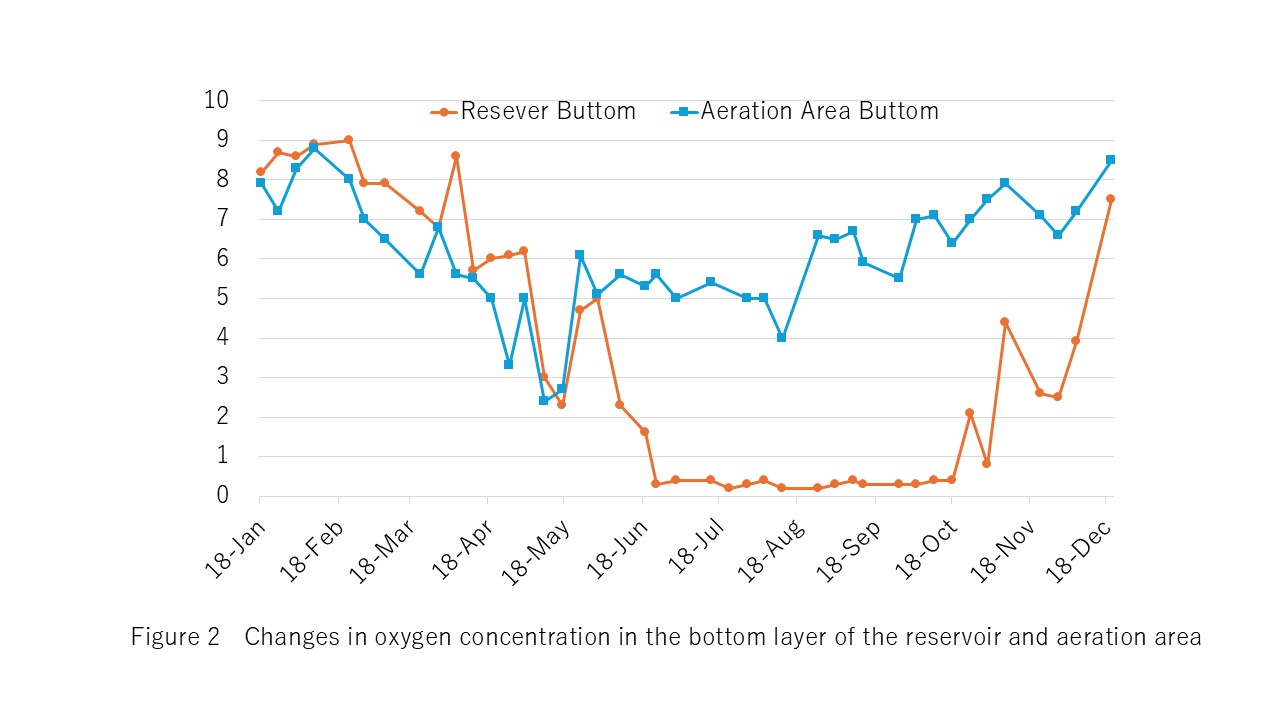
The main measurement items were dissolved oxygen (the reservoir and the aeration area bottom layer) and COD concentration, and field observations were conducted once a week. The DO concentration (Figure 2) in the bottom layer of the reservoir was less than 1 mgL-1 during the period from June 23 to October 18. However, the DO concentration in the bottom layer was larger than 4 mgL-1 in the aeration area field where the device was used, and anoxic conditions in the bottom layer did not occur. As a result, as shown in Figure 1, blue-green algae did not occur in the aeration area even though blue-green algae occurred in the reservoir.