Oral Presentation World Lake Conference 2025
Automated real-time methane monitoring system to provide insights into environmental drivers of emissions from reservoirs (#20)
Greenhouse gas (GHG) emissions from reservoirs contribute significantly to atmospheric GHG levels, further exacerbating global warming. Despite being emitted in lower quantities than carbon dioxide, methane has a global warming potential 34 times greater. Global estimates reveal that methane emissions from lakes and reservoirs constitute 10 % - 34 % of the total global emissions from natural and anthropogenic sources. Methane follows two major emission pathways: bubbling from the sediments and diffusion from the water column across the entire water surface. The prevalence of bubbling-based fluxes is controlled by a variety of environmental factors. These include, water depth, sediment quality, atmospheric pressure, and water level changes. Methane emissions require long-term continual monitoring to accurately estimate both the rate and spatial extent of bubbling events, which are rarely constant. Traditional manual sampling techniques are inadequate for monitoring during highly dynamic events. This is due to accessibility and safety concerns. This highlights the need for advanced monitoring techniques to provide further insights into these emissions. In this presentation we summarise the development and testing of an automated, real-time methane monitoring system for lakes – the Monitub system.
The Monitub system automates methane sampling by using a custom-built floating chamber, datalogger, sensor and venting system. This provides permanent deployment capability in reservoirs. This system is scalable and can be readily integrated into routine monitoring of total methane emissions, providing insights into local environmental drivers. In February 2025, this system, consisting of multiple surface venting chambers, an autonomous surface vessel, and a water quality monitoring buoy, was deployed on Lake Borumba, Queensland, Australia. During its deployment Monitub has experienced significant changes in both bubble emission rates and bubbling areas. Monitub chambers, in an inflow arm of Lake Borumba, showed dependence on atmospheric pressure and water level, suggesting domination by bubbling fluxes, which depend on hydrostatic pressure at the bed for bubble formation. Conversely, the chamber positioned outside of the inflow arm showed minimal pressure-related emission changes, responding instead to wind speeds.
The Monitub system has enabled automated, real-time monitoring of methane emissions from Lake Borumba. This enhances the understanding of local environmental drivers at a higher temporal fidelity than possible through traditional methods. This system is reliant on relatively cheap components and can be applied to a wide variety of aquatic water bodies, providing a feasible approach to further constrain the range of global estimates of methane emissions from lakes and reservoirs.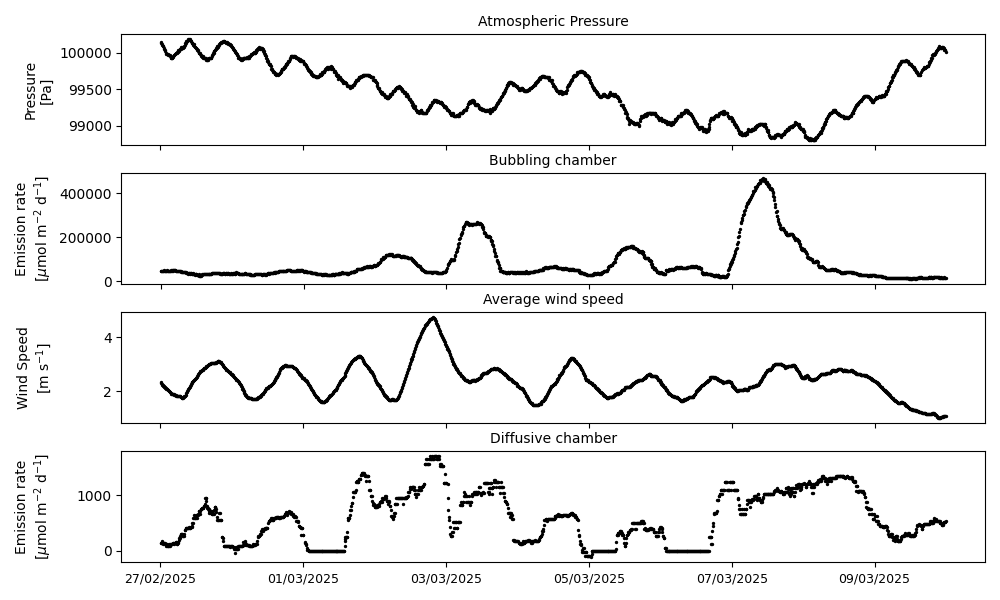
- Myhre, G., Shindell, D., Bréon, F., Collins, W., Fuglestvedt, J., Huang, J., Koch, D., Lamarque, J., Lee, D., Mendoza, B., Nakajima, T., Robock, A., Stephens, G., Takemura, T., Zhang, H., Qin, D., Plattner, G., Tignor, M., Allen, S., … Midgley, P. (2013). Anthropogenic and Natural Radiative Forcing. In: Climate Change 2013: The Physical Science Basis. Contribution of Working Group I.
- Deemer, B. R., & Holgerson, M. A. (2021). Drivers of Methane Flux Differ Between Lakes and Reservoirs, Complicating Global Upscaling Efforts. Journal of Geophysical Research: Biogeosciences, 126(4). https://doi.org/10.1029/2019JG005600