Oral Presentation World Lake Conference 2025
A hybrid approach for cyanobacteria forecasting in freshwater systems (#38)
Cyanobacteria blooms are a common phenomenon in Australian inland waters. Since the 1,000 km long bloom on the Darling River during the summer of 1991, which drew national and international attention, several outbreaks have affected the Murray-Darling River system, culminating in a 1700km stretch along the Murray River in 2016. Such outbreaks of cyanobacteria blooms pose high risks to freshwater ecosystems, public health, the economy, and recreation.
This study focused on three Australian lakes with distinct limnological characteristics, primary uses, and cyanobacterial bloom challenges. Lake Hume, the largest monomictic reservoir in the Murray-Darling Basin, supports downstream irrigation and has historically contributed to blue-green algae occurrences in the Murray River. Grahamstown Dam, a polymictic drinking water source for the Hunter region in NSW, frequently experiences potentially toxic cyanobacterial events. Lake Tuggeranong, a recreational urban lake in Canberra, is often closed due to elevated cyanobacteria levels. The differences in limnological conditions and operational functions make these lakes representative of diverse inland water bodies across Australia.
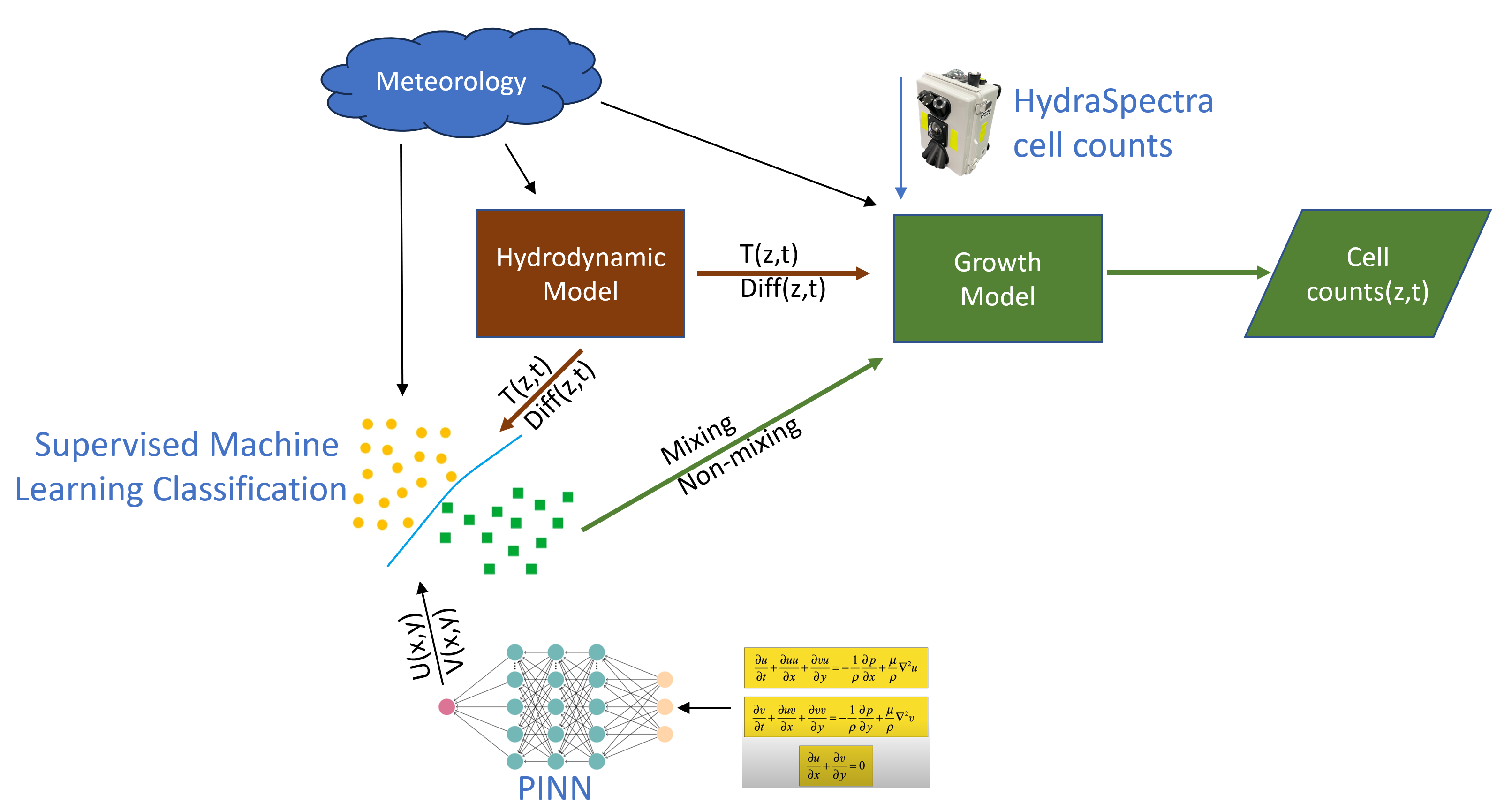
On these lakes, we have traditional thermistor chains and novel hyperspectral sensors installed, measuring the reflectance from the water surface, similar to satellite sensors but with a higher spectral resolution and not impacted by cloud coverage. A short-term forecasting framework was applied across these systems, simulating the distribution of buoyant cyanobacteria species using an algal growth model coupled with a turbulence hydrodynamic model. The model was driven by meteorology and re-initialized daily with cyanobacterial cell counts derived from hyperspectral reflectance. Simulations of cyanobacteria concentrations captured the dynamic mixing processes within the lakes, characterized by daily near-surface accumulation followed by redistribution driven by wind-induced mixing or nocturnal cooling. Accurate estimation of cyanobacteria surface concentrations at sub-daily timescales necessitates the integration of high-resolution water temperature profiling, hyperspectral reflectance measurements, and quantified diurnal mixing dynamics.
In parallel, a novel hybrid modeling approach combines inputs from a hydrodynamic model, Physics Informed Neural Networks, and empirical mixing criteria. Supervised Machine Learning methods were used to classify mixing and non-mixing conditions in stratified flows at the Darling River at Menindee. These mixing diagnostics can be integrated into the growth model to improve the cell count distribution forecasting outputs.
By incorporating in-situ observations, novel “near-surface” hyperspectral remote sensing, coupled process-based models, and knowledge-informed Machine Learning, the study demonstrates the viability of a hybrid short-term forecasting approach for cyanobacterial blooms. This comprehensive approach improves risk assessment for cyanobacterial blooms and supports informed water management strategies.